
The Ultimate Guide to Construction Job-Costing in Florida: How to Protect Your 30% Margin in Buildertrend

It’s the nightmare every Florida general contractor knows too well:
You estimate a custom home or commercial build in Tampa at a 30% gross profit margin. The job runs for eight months. The crew works hard, the client seems happy, and cash keeps moving through the bank account. But when your accountant hands over your end-of-year tax return in March, the truth hits: You finished at 14% gross margin.
Where did the other 16% go? It bled out softly—$500 in unbilled lumber here, a $2,000 subcontractor change order there, double-paid Florida sales tax, and three weeks of unallocated labor.
According to industry data, only 5 out of 100 builders hit their target profit margin within 1%. The other 95% lose profit not because they are bad builders, but because they look at their financial reports too late.
In this guide, we break down why traditional accounting fails Florida contractors and how to build a 15-minute weekly job-costing system in Buildertrend that protects your profit before the job is closed.
1. The Post-Mortem Trap: Why End-of-Year Taxes Aren't "Accounting"
Most small to mid-sized construction firms in Tampa Bay rely on cash-basis tax accounting provided by a general CPA at tax time.
Checking your project profitability at the end of the year—or at project closeout—isn't financial management. It’s an autopsy. You are simply examining the financial corpse of your project to figure out what killed your profit.
Why Closeout Audits Fail:
The Job is Closed: The scope of work is complete.
The Subs are Paid: You’ve already released final payments and signed unconditional lien waivers.
The Client Has Moved In: You no longer have leverage to invoice for scope creep or verbal change orders.
Once a project reaches closeout, you cannot fix a single dollar. True financial control happens in real-time on the job site, week by week.

2. Accrual vs. Cash: The WIP (Work in Progress) Misconception
In Florida construction, cash in the bank does not equal profit.
A contractor might have $150,000 sitting in their Chase business account in July after receiving a massive mobilization deposit from a client. It feels like a profitable month. However, $120,000 of that cash is already committed to lumber suppliers, framing crews, and upcoming concrete pours.
Without Job-Costing and Work-in-Progress (WIP) reporting, you risk using Client B's deposit to pay off Client A's budget overruns. This creates a dangerous cash-flow snowball that eventually crushes construction companies during market slowdowns in Tampa Bay.
3. The 3 Columns in Buildertrend That Lock In Your 30% Margin
Software like Buildertrend or JobTread gives builders live tracking power, but 90% of contractors only use 20% of its capabilities (mostly for scheduling and photo sharing).
To run an operational financial system, you must audit three live columns in your Buildertrend Job-Costing module every single week:
[ Budgeted Cost ] ───> [ Spent So Far ] ───> [ Still Committed ]
1. Budgeted Cost
This is your baseline estimate. It represents what you planned to spend on every cost code (foundation, framing, electrical, plumbing).
2. Spent So Far
This reflects actual vendor invoices, supplier bills, and internal payroll that have been approved and paid.
3. Still Committed Costs (The Most Important Column)
This is where contractors lose their profit. Committed Costs represent Purchase Orders (POs) issued to suppliers and subcontracts signed, even if the check hasn't left your bank account yet.
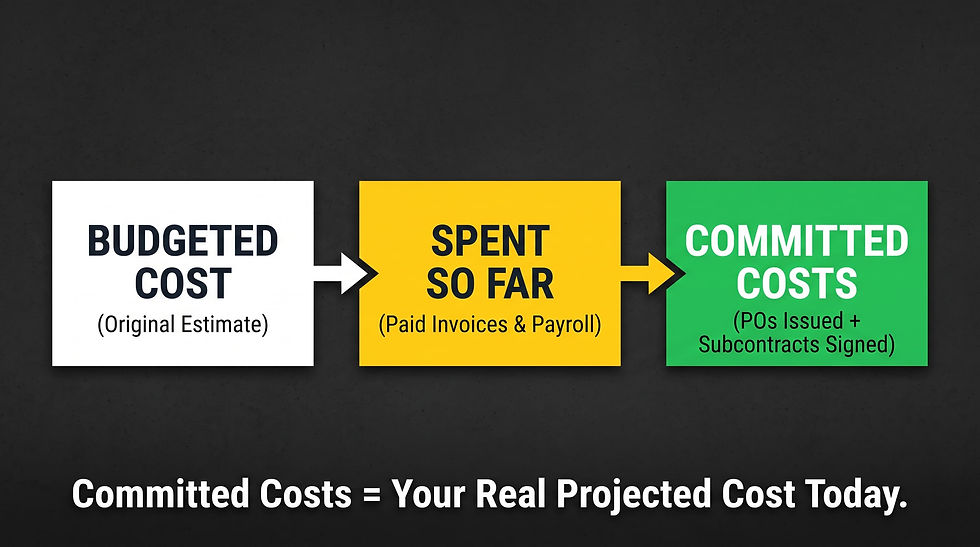
The Rule: If you only look at "Budgeted" vs. "Spent," a job will look under budget until the moment all invoices arrive. Adding "Committed Costs" gives you the True Total Projected Cost of the job today.
4. The 3 Hidden Profit Killers in Florida Construction

Even with Buildertrend installed, clean numbers require eliminating three common operational mistakes specific to Florida contractors:
A. The Verbal Change Order Trap
A client asks for an upgraded quartz countertop on-site in South Tampa. Your crew does the work. You bill for it at project completion. The client refuses to pay because it wasn't approved in writing.
The Fix: Implement a strict rule—no materials are ordered, and no tools touch the site until a Change Order is digitally signed inside Buildertrend with updated pricing AND timeline extensions.
B. Misclassifying Florida Sales Tax
Florida’s Department of Revenue aggressively audits construction trades. If you operate on a lump-sum contract versus a cost-plus contract, the rules for paying sales tax on materials change drastically. Paying tax to your supplier AND charging sales tax to your end client wastes thousands of dollars a year in double taxation.
C. Signing Unconditional Lien Waivers Too Early
Signing an Unconditional Lien Waiver before the check actually clears your bank account waives your legal right to file a mechanic’s lien in Florida—even if the client's check bounces. Always use Conditional Upon Progress Payment Waivers until cash is cleared.
5. The 15-Minute Friday Audit Protocol
Winning contractors in Tampa Bay don't get surprised in March; they get warned in Week 3.
Set aside 15 minutes every Friday before closing your job sites to run this workflow:
Reconcile Supplier Invoices: Match every Home Depot or supply house invoice against an issued Purchase Order in Buildertrend.
Review Subcontractor Pay Apps: Verify work completed on-site before approving sub payments.
Check the "Committed Costs" Variance: Look for cost codes flashing in red. If framing is 15% over budget in Week 3, you still have time to adjust allowances on finishes or cut costs elsewhere.
Stop Running Autopsies on Your Profit
Buildertrend is an incredible tool, but garbage data in equals dead margins out. If supplier bills sit disorganized on your truck's dashboard and bank accounts aren't reconciled weekly, your software reports are lying to you.
At Concrete Bookkeeping, we don't just do your end-of-year taxes. We act as your remote operational finance team in Tampa Bay, cleaning up your Buildertrend setup, reconciling job costs weekly, and protecting your margins on every build. Book a free consultation below, and let's explore if we are a good fit to give you the financial clarity and control that your business needs to scale to the next level.
Comments